
The Science Behind The Balm

Not Aftercare.
Medicine.

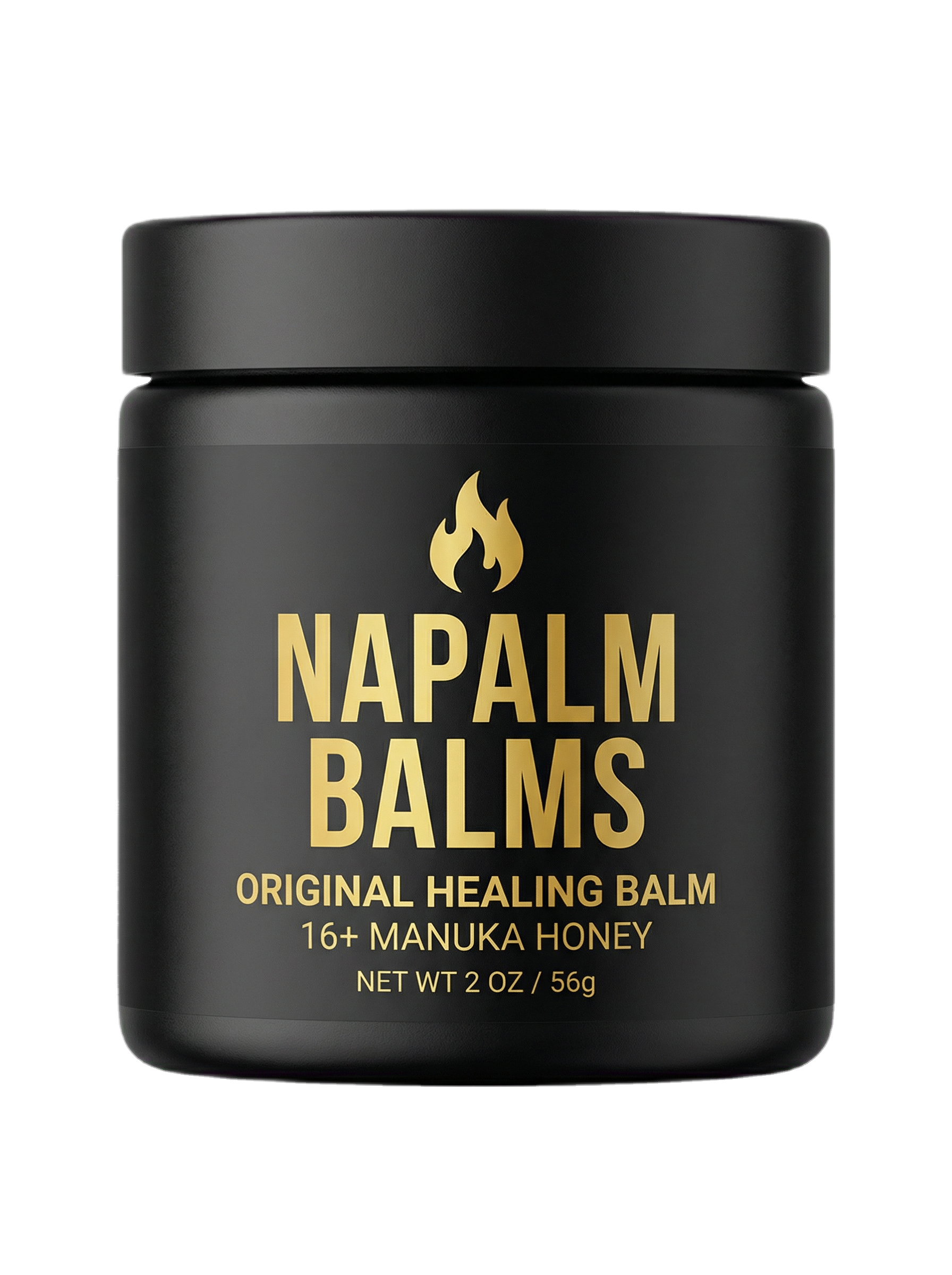
Most tattoo aftercare is petroleum jelly with a label. Napalm Balms is built around the most clinically studied wound-healing compound on earth — 16+ UMF Manuka Honey — and every other ingredient earns its place.

0days
Faster healing vs. conventional
0%
Wound contraction by day 9
16+
UMF therapeutic grade
100%
Natural ingredients
Active Compound Science

What Makes 16+ UMF
Different From Everything Else

UMF stands for Unique Manuka Factor — a grading system that measures the concentration of Methylglyoxal (MGO), Leptosperin, and DHA in Manuka honey. Only UMF 10+ has clinically significant antibacterial activity. We use 16+.

16+
Unique Manuka Factor
Regular HoneyUMF 0
Minimum TherapeuticUMF 10+
Napalm BalmsUMF 16+
Medical Grade MaxUMF 20+

The UMF rating directly correlates with Methylglyoxal (MGO) concentration — the compound responsible for Manuka honey's unique non-peroxide antibacterial activity. Only UMF 10+ and above has been shown to have clinically meaningful antibacterial potency.

4.2
Days Faster Wound Healing
Medical-grade honey reduces wound healing time by an average of 4.2 days compared to conventional treatments including povidone-iodine and standard dressings.
Source: PMC8706154 — Systematic Review, 2021
≥80%
Wound Contraction by Day 9
Topical application of Manuka honey achieved ≥80% wound contraction by day 9 in both diabetic and non-diabetic models — significantly outperforming controls.
Source: PMC6537647 — Comparative Wound Healing Study
MRSA
Active Against Drug-Resistant Bacteria
Manuka honey is currently used as a wound treatment and shown to be effective against MRSA — the most dangerous infection risk for fresh tattoos.
Source: Nature Scientific Reports, 2020 — Frydman et al.
321
Times Cited in Scientific Literature
The antibacterial properties of Manuka honey are among the most researched in natural wound care — with 321+ citations in peer-reviewed journals.
Source: PMC6613335 — Johnston et al., 2018
Head to Head

Napalm Balms vs.
Everything Else

Most tattoo aftercare products are petroleum-based. Here's what the science actually says about how they compare to a Manuka honey formula.

Napalm Balms
16+ Manuka Honey
Petroleum-Based
Vaseline / A&D
Absorbs into skin ✗ Sits on surface
Allows skin to breathe ✗ Occlusive barrier
Active antibacterial properties MGO + Bee Defensin-1 ✗ None
Prevents ink pulling / color loss ✗ Can cause irregular scabbing
Anti-inflammatory Calendula + Coconut Oil
Promotes new skin cell growth Stimulates fibroblast activity ✗ Passive barrier only
Infection risk Reduced — active antimicrobial ✗ May increase — traps bacteria
100% natural ✗ Petroleum byproduct
Clinically studied 321+ peer-reviewed citations Partial — for basic moisture only
Full Ingredient Breakdown

Every Ingredient
Earns Its Place

No fillers. No petroleum. No fragrance. Five ingredients — each one chosen for a specific, research-backed reason.

16+ UMF Manuka Honey
Primary Healer · Antibacterial · Anti-inflammatory
Sourced from the Leptospermum scoparium plant in New Zealand, 16+ UMF Manuka honey contains Methylglyoxal (MGO) at concentrations proven to inhibit bacterial growth, reduce inflammation, and accelerate the skin's natural repair process. It draws moisture from the air into the healing skin (humectant) while simultaneously creating an antibacterial environment.
"Manuka honey achieved ≥80% wound contraction by day 9 and reduced healing time by 4.2 days vs. conventional treatment." — PMC, 2021
Beeswax
Skin Barrier · Antimicrobial · Anti-inflammatory
Beeswax creates a breathable protective barrier that locks in the Manuka honey's active compounds without suffocating the skin. Unlike petroleum, it has natural antimicrobial and anti-inflammatory properties, making it effective for soothing irritated skin while allowing oxygen exchange — critical for proper tattoo healing.
"Beeswax has strong antiseptic, healing and anti-inflammatory properties." — Dr. Axe / ResearchGate
Coconut Oil
Emollient · Wound Healing · Anti-inflammatory
Virgin coconut oil is rich in lauric acid, a medium-chain fatty acid with proven anti-inflammatory and antimicrobial properties. It promotes angiogenesis (new blood vessel growth) in healing tissue, improves skin hydration, and acts as a carrier to help deliver the active Manuka compounds deeper into the skin.
"Coconut oil has anti-inflammatory, angiogenic, wound-healing, and skin protective properties." — ResearchGate, 2024
Vitamin E
Antioxidant · Skin Repair · Color Protection
Vitamin E (tocopherol) is one of the most studied antioxidants in dermatology. It neutralizes free radicals that damage healing skin cells, supports the skin's natural repair mechanisms, and helps maintain the integrity of the dermis where tattoo ink sits — protecting color vibrancy during and after healing.
"Vitamin E prevents oxidative damage to healing skin and supports dermal integrity." — Anti-Inflammatory Skin Barrier Review, PMC
Calendula Extract
Anti-inflammatory · Fibroblast Stimulation · Soothing
Calendula officinalis is one of the most clinically validated botanical ingredients in wound care. It dramatically reduces inflammation in the acute healing phase, promotes fibroblast activity (the cells responsible for new skin formation), and has been shown in human keratinocyte studies to accelerate the transition from inflammation to tissue repair.
"Calendula extract enhances wound healing by promoting fibroblast activity and reducing inflammation." — Cutaneous & Ocular Toxicology, 2025 (211+ citations)
⚗️
That's It.
No Fillers · No Petroleum · No Fragrance
Five ingredients. Every single one with a specific, research-backed purpose. No mineral oil, no synthetic fragrance, no preservatives, no petroleum byproducts. We don't add ingredients to make the formula look impressive on a label — we add them because they work.
Compare this to most aftercare products: 20+ ingredients, half of which are stabilizers, fragrances, and petroleum derivatives.
The Healing Timeline

How Napalm Balms Works
Through Every Phase

Tattoo healing happens in three distinct biological phases. Napalm Balms is formulated to support all three — not just the first 48 hours.

Days 1 – 3
The Plasma Phase
Your tattoo is an open wound. The skin is weeping plasma, the immune system is responding, and infection risk is at its highest. This is where Manuka honey's MGO compound does its most critical work — creating an antibacterial environment while the Calendula extract calms the inflammatory response.
  • Apply a thin layer 2–3× daily after gentle cleaning
  • MGO actively inhibits bacterial growth on the wound surface
  • Calendula reduces redness and swelling
  • Beeswax creates a breathable barrier — not a suffocating seal
Days 4 – 14
The Peeling Phase
The skin begins to peel and flake. This is the most critical phase for color retention — premature scabbing or over-drying causes ink to lift with the dead skin. Napalm Balms keeps the healing layer optimally moist without the irregular scabbing that petroleum products cause.
  • Apply 1–2× daily — less is more in this phase
  • Coconut oil maintains optimal moisture without over-saturation
  • Vitamin E protects the dermis layer where ink sits
  • Never pick — let the Calendula do the work
Week 3+
Long-Term Maintenance
The surface has healed but the deeper dermis continues to repair for weeks. Color vibrancy and line clarity depend on how well the skin was maintained through this phase. Regular application keeps the tattooed skin healthy, supple, and vibrant long-term.
  • Apply as needed — daily or every few days
  • Manuka honey continues to support skin microbiome health
  • Vitamin E maintains color depth and prevents fading
  • Beeswax protects against environmental damage
The Problem With Everything Else

Why Petroleum
Fails Your Tattoo

Petroleum jelly has been used in wound care for over 150 years — but new research and tattoo-specific studies are revealing serious problems with using it on fresh ink.

🚫
It Blocks Oxygen
Petroleum jelly is fully occlusive — it creates an airtight seal on the skin. Healing skin needs oxygen exchange. Blocking it slows the natural repair process and can create an environment where anaerobic bacteria thrive.
It Causes Irregular Scabbing
The over-occlusive barrier traps too much moisture, causing the skin to macerate (soften and break down). This leads to irregular scabbing — and when those scabs lift, they take ink with them. Color loss and blowouts are often the result.
🦠
It Has Zero Antibacterial Properties
Petroleum jelly is an inert substance — it does nothing to prevent infection. A BBC-reported study found that oil-based substances may actually increase infection risk by disrupting the skin's natural wound-healing process.
It Doesn't Absorb
Petroleum jelly sits on top of the skin — it cannot penetrate the dermis. This means none of its "moisturizing" effect reaches the healing tissue. It's a passive barrier, not an active healer.
Research Says

"Oil-based substances, such as petroleum jelly, appear to disrupt this important process, and might increase the risk of wound infection."

— BBC Health / Wound Healing Research, 2018

"Petroleum-based products can cause irregular scabbing because they are too occlusive — this can cause ink pulling and color loss."

— Mad Rabbit Tattoo Research, 2023

"The occlusive nature of petroleum jelly can prevent the tattoo from receiving adequate oxygen, which can also contribute to fading."

— Skin Jungle, Tattoo Aftercare Research
What Customers Say

The Results
Speak For Themselves

★★★★★

"My tattoo healed in half the time compared to when I used Aquaphor on my last one. The colors stayed so vivid — my artist even commented on how clean the heal was."

Marcus T. — Full sleeve, healed in 8 days
★★★★★

"I've been tattooed 14 times. This is the only aftercare that didn't cause any scabbing at all. The ink retention on my latest piece is insane compared to anything I've used before."

Jade R. — Tattoo collector, 14 pieces
★★★★★

"As a tattoo artist I've tried everything. I now recommend Napalm Balms to every single client. The healing speed and color lock is unlike anything else I've seen in 12 years of tattooing."

Kai S. — Professional Tattoo Artist, 12 years

Your Ink
Deserves Better.

Stop putting petroleum on a wound. Start healing the way your skin was designed to.
Added to Cart
View Cart